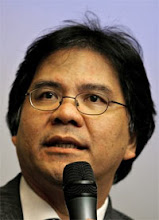
Asia ex-Japan is mostly given a pass in the swirling global concerns about sovereign debt, but the region has its worrisome deficit cases, such as India. Add to that roster Malaysia, which means another assignment for national troubleshooter Idris Jala.
As Prime Minister Najib Abdul Raza's designated "driver" of economic and social reform, Jala has been telling government ministries and the public the same thing: If Malaysia did not immediately slash subsidies and make other changes, its government debt of $110 billion could rise to 100% of GDP by 2019.
"When this happens, Malaysia will become bankrupt. We do not want to become another Greece," he said. Najib has since said "prudent" measures are being taken to reduce public debt. (These aren't yet slated to change much.)
Transformation is 52-year-old Jala's specialty. As chief executive he led the spectacular turnaround of the national carrier, Malaysian Airline System (MAS). When he took the helm in late 2005, on leaving a top post at a Shell oil affiliate, MAS was bleeding cash and had losses to the tune of $400 million. He wasted no time eliminating thousands of jobs and brutally terminating unprofitable routes. These were unpopular decisions, but two years later MAS emerged--before the recession--with record earnings of $260 million.
Jala's work did not go unnoticed. He was approached by Najib, then new to the pm job, to join the civil service. He says, "It was also time for me to leave MAS because the team can do the job. My successor (Tengku Azmil Zahruddin Raja Abdul Aziz) is a great person and had been groomed to take over. Leadership is about being redundant."
The prime minister, who took over a faltering alliance that has ruled Malaysia since independence, evidently isn't keen on a redundancy when voters get another shot in parliamentary elections in 2012 or 2013. Thus, the call to Jala to assume his ministerial-level post and senatorial status.
His new reform agenda extends well beyond disciplining the welter of public subsidies and other budget busters. He is also tasked with addressing crime, corruption and falling educational standards. Recently FORBES ASIA sat down with Jala in Kuala Lumpur to ask about his efforts.
Forbes Asia: The prime minister unveiled a new economic model. What is your role in making this a reality?
Jala: We'll run labs involving key sectors like oil and gas, tourism and palm oil. In the tourism lab, for example, we'll discuss how to double tourism receipts in ten years. We have persuaded the private sector to nominate their best and brightest minds to spend time with us full-time at the labs and to come up with solutions.
Several pressure groups like Perkasa, a group that claims to champion Malay rights, want affirmative action to stay. At the same time, the government talks about further liberalizing the economy. How does the government manage different interests?
For one Malaysia to exist we must embrace and accept the different polarities like the Bumiputeras (Malays and indigenous people) versus non-Bumiputeras. We need to allow people to express their views differently and appreciate that there will be tension. You can't fix the problem by removing one polarity, as it'll destabilize the system.
What is being done to address corruption in Malaysia?
The Witness Protection Act has been approved by Parliament. From our rough estimate based on publicly available data, there were 120 offenders convicted since the beginning of this year, including one member of parliament, representing a total of $530 million in cash bribes. We've not caught any big fish yet. We're also tackling corruption in procurement, with details on 2,665 government contract awards published on a procurement website set up by the Ministry of Finance. Transparency is good, and we will keep doing this.
Eighty percent of Malaysians have only a high school degree or less. What is being done to raise educational standards?
We have started 929 preschool classes--18,000 children are benefiting from this, mainly in rural areas. Fifteen thousand remedial teachers have been trained. And 7,616 primary schools have been ranked to focus on results. There are questions on why the government reversed its decision to teach mathematics and science in English. Korea is successful teaching these subjects in the Korean language because they have quality teachers. In the labs we ran we concluded the problem in Malaysia was the quality of teaching. So we must focus on that before we talk about medium of instruction. This was a tough call. The government was advised that rural children have difficulties understanding English. When implementing policies, you have to identify who the majority is or who is most impacted by your policies, not those who make the loudest noise. This has been my biggest challenge since joining the civil service.
Reforms on subsidies for petrol and utilities are needed to reduce Malaysia's fiscal deficit. That's going to require political will. How are you going to approach this problem?
Nobody will dance in the streets if you tell them you're going to withdraw subsidies. This is one of my biggest challenges. Last year total subsidies were $23 billion. This is 4% to 5% of GDP, higher than in countries like Indonesia and the Philippines. We have to scale back to reinvest in other areas of the economy to become a high-income nation. Subsidies have to be withdrawn gradually rather than in a big-bang approach.
And what of the crime problem?
Crime has been rising for the last three years, but we managed to bring the index crime rate down by 15% and reported street crime rate by 40% in the first quarter of 2010, compared with the same period last year. We spent six weeks collecting data to find out why and where crime happens and ran labs, very intense sessions, to find solutions. Among many measures, we mobilized 14,200 police officers to 50 hot spots, and the police have to explain and report on a weekly basis to the prime minister on what they're doing to reduce crime. Street crime has been reduced but not organized crime. The latter remains high because they're syndicated.
Much of Malaysia is still rural ...
Rural basic infrastructure also saw big improvements. The government is spending more money than ever on this. About 400 kilometers of roads were completed in the first quarter and another 350 are under construction. Eight hundred and eighty-four households were connected with water supply and 347 with electricity. I went with the prime minister to Sarawak on a trip to launch an electricity project. The people living in the longhouses [traditional native homes] were very grateful for this. It was quite an emotional event for me. I called my wife, and told her "Even for this alone, I'm grateful I joined the government." These people ask for very little.
How do you transform the civil service and get it to act with more urgency?
We have to change the way we do things in order to transform character. Ambitious targets have to be set to force people to radically change the way they work. When we published that we want to reduce crime by 20%, people asked if I was crazy, but we managed to bring crime down. The prime minister is hands-on and chairs monthly delivery task force meetings. I hold weekly problem-solving meetings with various ministers, who set their targets, which are published in a book for accountability.
Any recipe for staying focused?
Helen Keller said, "Keep your face to the sunshine and you'll never see shadows." I have no difficulties doing something that won't succeed. The thing I ask myself is whether I did my best and whether that's good enough. It's a very liberating mindset. You have to see this as a calling, not a job.
Source: Forbes Asia